Wednesday, 21 October 2015
Tuesday, 13 October 2015
Flush n Wash Toilets
I had seen these toilets in Japan many times and thought what a great idea it was. No need to touch a tap, just rinse your fingers by putting it under the tap as the toilet replenishes its water.

I am really pleased that this is a Malaysian invention. Amazing isn't it? Actually, since Malaysia makes many bathroom fittings products, we do have many other bathroom inventions. The exposed toilet flush, I think was invented by a Malaysian. He meant it to be a foot flush. The cost savings of installing one of these and its clean design made architect not think about its construction and installed it in many public toilets. It is sometimes too hard to push, as it is meant to be used by a foot, and placed at inaccessible place behind the toilet, discouraging those who can't not to flush the toilet. Sigh!
http://www.apanama.com.my/robest/de-inventions-flush-n-wash.php

I am really pleased that this is a Malaysian invention. Amazing isn't it? Actually, since Malaysia makes many bathroom fittings products, we do have many other bathroom inventions. The exposed toilet flush, I think was invented by a Malaysian. He meant it to be a foot flush. The cost savings of installing one of these and its clean design made architect not think about its construction and installed it in many public toilets. It is sometimes too hard to push, as it is meant to be used by a foot, and placed at inaccessible place behind the toilet, discouraging those who can't not to flush the toilet. Sigh!
http://www.apanama.com.my/robest/de-inventions-flush-n-wash.php

Monday, 12 October 2015
Malaysian made II
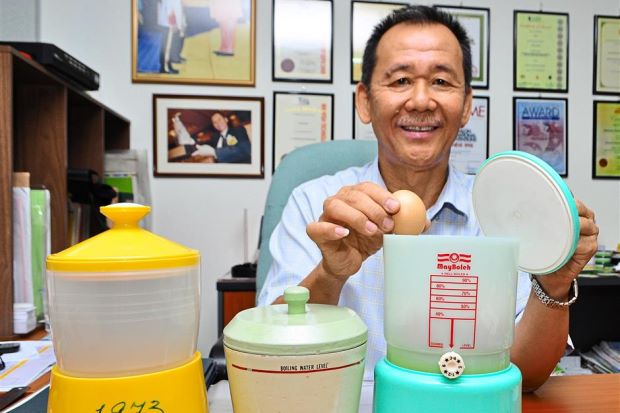
The soft boiled egg maker Datuk Hew Ah Kow

The Rubber stamp maker Mr Robest Yong

The hexagon Nehemiah walls Mr Nehemiah Lee

The Lytro camera Mr Ren Ng

Water dispensers by Mr Ooi Seng Chye

The flipper toothbrush holders by Goo Yock Tee

Flash drive by Pua Khein Seng

Loom bands Cheong Choon Ng
Saturday, 10 October 2015
Malaysia in the UN
Guardians of world peace
BY COLONEL RAMLI H. NIK - 10 OCTOBER 2015 @ 11:01 AM
UPON gaining independence on Aug 31, 1957, the Federation of Malaya joined the United Nations (UN) on Sept 17, 1957. As a small and developing nation facing a communist insurgency, Malaya had the political will and commitment in promoting international peace and security as stipulated in the UN Charter.
Three years later, following the UN Security Council Resolution 143 (1960) in July 1960, Malaya was selected to participate in the UN Force in the Congo (ONUC). The mandate of ONUC was to facilitate the withdrawal of Belgian troops, maintain law and order, help to establish and legitimise the post-colonial government of Congo (later became Zaire and now known as Democratic Republic of Congo).
As a commitment towards international peace and security, a contingent of 1,947 military personnel, known as the Malayan Special Force to the Congo, was despatched and served from October 1960 to April 1963. As emphasised by the first prime minister, Tunku Abdul Rahman Putra Al-Haj, the new nation should visibly demonstrate its faith in the UN by responding positively to its peacekeeping role at the international level. This was indeed an honour to a newly-independent nation of Malaya and testimony of our credibility in promoting peace and stability.
This discussion highlights Malaysia’s contributions to the UN peacekeeping operations which have attained international recognition with respect to promoting peace and security. As the first nation from the Southeast Asian region that successfully participated in ONUC, the Malaysian peacekeeping force has continued to maintain a number of firsts and acceptability at international level.
On Jan 1, 1965, Malaysia was elected to serve as a non-permanent member of the UN Security Council, which is another high level achievement, but the selection/achievement created an upset in Jakarta.
In the same year, the Republic of Indonesia, while pursuing a policy of confrontation against the newly-formed Federation of Malaysia, withdrew as a member of the UN and its related agencies. However, before the opening of the UN General Assembly Session in September 1966, Indonesia rejoined the UN.
With a strong track record of promoting peace and security in our foreign policy, in the voting for the UN Security Council seat for 1989/1990, Malaysia received 143 votes out of 170 member states of the UN. As a member of the UN Security Council, it was most timely to participate in the peacekeeping operations with the flare up in Namibia in the same year. The Security Council established the UN Transition Assistance Group (UNTAG) in Namibia on Feb 16, 1989, with the responsibility for monitoring the ceasefire, overseeing the withdrawal of the South Africa Defence Force, and controlling the borders.
Once again, Malaysia was selected to provide an infantry battalion to be part of the military component. The deployment of the Malaysian contingent in UNTAG was the second successful contribution in peacekeeping operations after a lapse of nearly three decades of being inactive. Also, this marked the beginning of the Malaysian Armed Forces (MAF) playing key roles in providing military contingents and observers for peacekeeping operations, especially with the commitment of the Malaysian contingent for the UN Transitional Administration in Cambodia in early 1992 and continued to participate in other peacekeeping missions as required by the UN.
In recognition of the MAF’s committed effort in peacekeeping, which has impressed UN policymakers, especially the Security Council, the UN gave the honour to Malaysia on Jan 18, 1994, when Lieutenant-General Aboo Samah Aboo Bakar was selected as the first Malaysian force commander of the UN Operation in Somalia (UNOSOM II), replacing General Cevik Bir from Turkey. In the history of peacekeeping operations since 1948, Aboo Samah was also the first force commander from Southeast Asia.
There are two other important firsts scored by Malaysia.
With the need to keep abreast with the doctrine and to maintain high standard of training, the fact that peacekeepers have to operate in more complex and dangerous environments, the MAF pursued with bold commitment to establish the Peacekeeping Training Centre in Port Dickson in June 9, 1995, and it was recognised by the UN as the first training centre in the region.
To date, the centre has trained 1,931 Malaysian officers and 612 international participants from 52 countries. In addition, to ensure coordination and planning for participation in future deployment of Malaysian contingents, including military or police observers to mission areas in accordance with procedures of the Department of Peacekeeping Operations at the UN headquarters, MAF approved the appointment of a military adviser at the Malaysian Permanent Mission to the UN in New York in January 1996.
Indeed, Malaysia is not only the first Asean member to have a military adviser dedicated for peacekeeping duties at the Permanent Mission, but also joins the community of 50 military advisers or police advisers of UN member states.
In conclusion, the Malaysian peacekeeping force has continued to exert its influence with credibility and capability at the international arena, especially with a commitment by Prime Minister Datuk Seri Najib Razak to provide an infantry battle group for the UN Standby Force for peacekeeping operations during the UN Peacekeeping Summit in New York on Oct 2.
Of significant importance, MAF has participated in 35 peacekeeping operations with the deployment of more than 30,000 military and police personnel successfully, but with 18 killed as casualties. The writer is a senior fellow, Department of Strategic Studies, National Defence University of Malaysia and former military adviser at the permanent mission of Malaysia to the United Nations
Friday, 9 October 2015
Malaysian books
1. Malayan Trilogy
Perhaps best known for his dystopian science fiction novel A Clockwork Orange, Anthony Burgess lived and worked as a teacher in Malaya during the 1950s. Whilst there, he became fluent in Malay and spent part of his free time writing fiction and musical scores. Burgess’s famous Malayan Trilogy, published in the 1950s, covers the often comic adventures of a history teacher working against the backdrop of the Malayan Emergency.
2. The Casuarina Tree
During the first half of the 20th century, Somerset Maugham was one of the highest paid and most acclaimed writers in the world. He also worked as a spy for the British Secret Service. Maugham travelled extensively through South East Asia and wrote a wide variety of works set in Malaya and Borneo. One of his most famous collections of short stories is The Casuarina Tree, which follows the lives of expat planters and pioneers living in Malaya during the 20s.
3. The Malay Archipelago
Often called ‘the father of biogeography’, Alfred Russel Wallace is up there with Charles Darwin as one of the most famous naturalists of all time. From 1854 to 1862, Wallace travelled throughout Malaysia (then the Dutch East Indies) and the surrounding islands, collecting thousands of natural specimens. Wallace’s ground-breaking discoveries and exciting exploits were recorded in his most successful work The Malay Archipelago, which continues to thrill and inform readers today.
4. Lord Jim
There are few authors as celebrated and controversial as Joseph Conrad. Though he travelled extensively by ship along the coast of Malaya and other South East Asian countries, he spent relatively little time on land. As a result, his depictions of Malay culture in his novels have been criticized as inaccurate and racist. One of Conrad’s most famous novels, Lord Jim, covers the exploits of a young English seaman who becomes leader of a settlement populated by Malays and Bugis.
5. The Golden Chersonese
As a pioneering travel writer, photographer, naturalist and the first woman to be elected Fellow of the Royal Geographical Society, Isabella Bird lived a far more exiting life than most women of her day. Her amazingly detailed work The Golden Chersonesecovers life in the urban settlements and jungles of Malaya and Singapore in the late 19th century. It is also one of the world’s oldest surviving travel accounts written by a woman.
6. The Jungle is Neutral
During the Second World War, British Army officer F. Spencer Chapman led numerous successful skirmishes against the Japanese, at times working alongside the Malayan Chinese Communists. Fighting jungle diseases and harsh terrain, as well as the Japanese, Chapman and his men (all disguised as Chinese laborers) eventually escaped to Pangkor Island, where they were picked up by a British submarine. It seems only a matter of time before Chapman’s thrilling story, recorded in his memoir The Jungle Is Neutral, becomes a Hollywood blockbuster!
7. The Rain My Drink
Born in China to Eurasian parents, author and physician Han Suyin truly broke into the literary scene with the 1952 novel A Many Splendored Thing, which inspired a 3-time Oscar winning film and a popular theme song. Han Suyin travelled to Malaya during the communist insurgency with her husband (a British Officer), where she worked in Johore Bahru General Hospital. Her experiences there led her to write the controversial novel And The Rain My Drink, which almost ruined her husband’s career due to its anti-colonial slant
8. The War of the Running Dogs
Anyone looking to read a riveting account of the Malayan Emergency from the British perspective cannot go past Noel Barber’s The War of the Running Dogs. Barber’s work reads like a first-class thriller, but it is still informative and filled with the stories of ordinary planters as well as the key military players. After his time in Malaysia in the 1950s, Barber went on to write a wide range of novels spanning a number of genres.
9. The Virgin Soldiers
Despite having spent a tour of duty doing military service against the Malayan communists, the works of Leslie Thomas are far removed from Barber’s serious account of the war. Leslie’s 1966 novel The Virgin Soldiers is a comedy, partly inspired by his own experiences during the Malayan Emergency, and revolving around a delicate love triangle. Fairly risqué for its day, The Virgin Soldiers inspired two movies (the first featuring an uncredited David Bowie!).
10. Scorpion Orchid
The Sri Lankan born Malaysian author Lloyd Fernando worked as an English professor for the University of Malaya until retiring in 1978. His celebrated novels Scorpion Orchid and Green Is The Colour deal masterfully with themes of racial diversity and conflict in Kuala Lumpur and Singapore. The works of Lloyd Fernando are still counted among the finest fiction to come out of South East Asia.
11. Penang: The Fourth Presidency of India
Anyone interested in the vivid story of Penang during the days of the British East India Company should be sure to pick up a copy of Marcus Langdon’s Penang: The Fourth Presidency of India 1803-1830. This first volume of a planned series of four history books covers some of the most pivotal moments of the island’s colonial history. A British-born Australian, Langdon was partly inspired to write a detailed history of Penang after discovering ancestral connections to the island. He currently lives in Penang under the Malaysia My Second Home program.
12. The Dulang Washer and Shadors Beneath the Fronds
Irish author Paul Callan has written two recent and highly praised historical novels both set in Malaysia. His IMPAC Literary Award longlisted novel, titled The Dulang Washer, is a drama set in the harsh tin-mine camps of Perak toward the end of the 19th century. The second novel, Shadows Beneath The Fronds, is set partially on the plantations of Malaysia. The story follows a friendship between a boy and girl from Tamil families that is tested by separation and hardship. Paul Callan divides his time between his homes in Malaysia and London.
13. The House of Trembing Leaves
Talented storyteller Julian Lees was born in Hong Kong in 1967. His highly compelling 2013 novel The House of Trembling Leaves features a daring female protagonist who must struggle to survive a forced marriage, then the Japanese invaders and, finally, the communist guerillas. Julian Lees currently lives in Kuala Lumpur with his family.
14. Memoirs of a Rubber Planter, Bandit fighter and Spy
In his Malayan Spymaster: Memoirs of a Rubber Planter, Bandit Fighter and Spy, Boris Hembry covers in exciting detail his exploits during the Japanese occupation and the communist guerilla war. Hembry’s memoir of his time as an English spy are filled with enthralling accounts. Some examples include trapping a rogue tiger, reporting on Japanese camps in Burma, and even being part of a covert operation spearheaded by Freddie Spencer Chapman.
15. The Kuala Lumpur at War
Historian Andrew Barber is best known for his 2012 book Kuala Lumpur at War 1939-1945. This impressive work brings to life the experiences of ordinary Malaysians who lived in Kuala Lumpur during the Japanese occupation. The book masterfully combines interesting anecdotes with information collected from newspapers, military archives and a wide range of other materials. Andrew Barber, a former English diplomat, lives in Malaysia with his wife and two children. You can read the Expat Go Malaysia’s review of Kuala Lumpur at War 1939-1945 here.
http://www.expatgomalaysia.com/2015/10/01/15-international-authors-inspired-by-malaysia/#at_pco=smlrebh-1.0&at_si=5616a02d51eeeebf&at_ab=per-2&at_pos=0&at_tot=auto
7. The Rain My Drink
Born in China to Eurasian parents, author and physician Han Suyin truly broke into the literary scene with the 1952 novel A Many Splendored Thing, which inspired a 3-time Oscar winning film and a popular theme song. Han Suyin travelled to Malaya during the communist insurgency with her husband (a British Officer), where she worked in Johore Bahru General Hospital. Her experiences there led her to write the controversial novel And The Rain My Drink, which almost ruined her husband’s career due to its anti-colonial slant
8. The War of the Running Dogs
Anyone looking to read a riveting account of the Malayan Emergency from the British perspective cannot go past Noel Barber’s The War of the Running Dogs. Barber’s work reads like a first-class thriller, but it is still informative and filled with the stories of ordinary planters as well as the key military players. After his time in Malaysia in the 1950s, Barber went on to write a wide range of novels spanning a number of genres.
9. The Virgin Soldiers
Despite having spent a tour of duty doing military service against the Malayan communists, the works of Leslie Thomas are far removed from Barber’s serious account of the war. Leslie’s 1966 novel The Virgin Soldiers is a comedy, partly inspired by his own experiences during the Malayan Emergency, and revolving around a delicate love triangle. Fairly risqué for its day, The Virgin Soldiers inspired two movies (the first featuring an uncredited David Bowie!).
10. Scorpion Orchid
The Sri Lankan born Malaysian author Lloyd Fernando worked as an English professor for the University of Malaya until retiring in 1978. His celebrated novels Scorpion Orchid and Green Is The Colour deal masterfully with themes of racial diversity and conflict in Kuala Lumpur and Singapore. The works of Lloyd Fernando are still counted among the finest fiction to come out of South East Asia.
11. Penang: The Fourth Presidency of India
Anyone interested in the vivid story of Penang during the days of the British East India Company should be sure to pick up a copy of Marcus Langdon’s Penang: The Fourth Presidency of India 1803-1830. This first volume of a planned series of four history books covers some of the most pivotal moments of the island’s colonial history. A British-born Australian, Langdon was partly inspired to write a detailed history of Penang after discovering ancestral connections to the island. He currently lives in Penang under the Malaysia My Second Home program.
12. The Dulang Washer and Shadors Beneath the Fronds
Irish author Paul Callan has written two recent and highly praised historical novels both set in Malaysia. His IMPAC Literary Award longlisted novel, titled The Dulang Washer, is a drama set in the harsh tin-mine camps of Perak toward the end of the 19th century. The second novel, Shadows Beneath The Fronds, is set partially on the plantations of Malaysia. The story follows a friendship between a boy and girl from Tamil families that is tested by separation and hardship. Paul Callan divides his time between his homes in Malaysia and London.
13. The House of Trembing Leaves
Talented storyteller Julian Lees was born in Hong Kong in 1967. His highly compelling 2013 novel The House of Trembling Leaves features a daring female protagonist who must struggle to survive a forced marriage, then the Japanese invaders and, finally, the communist guerillas. Julian Lees currently lives in Kuala Lumpur with his family.
14. Memoirs of a Rubber Planter, Bandit fighter and Spy
In his Malayan Spymaster: Memoirs of a Rubber Planter, Bandit Fighter and Spy, Boris Hembry covers in exciting detail his exploits during the Japanese occupation and the communist guerilla war. Hembry’s memoir of his time as an English spy are filled with enthralling accounts. Some examples include trapping a rogue tiger, reporting on Japanese camps in Burma, and even being part of a covert operation spearheaded by Freddie Spencer Chapman.
15. The Kuala Lumpur at War
Historian Andrew Barber is best known for his 2012 book Kuala Lumpur at War 1939-1945. This impressive work brings to life the experiences of ordinary Malaysians who lived in Kuala Lumpur during the Japanese occupation. The book masterfully combines interesting anecdotes with information collected from newspapers, military archives and a wide range of other materials. Andrew Barber, a former English diplomat, lives in Malaysia with his wife and two children. You can read the Expat Go Malaysia’s review of Kuala Lumpur at War 1939-1945 here.
http://www.expatgomalaysia.com/2015/10/01/15-international-authors-inspired-by-malaysia/#at_pco=smlrebh-1.0&at_si=5616a02d51eeeebf&at_ab=per-2&at_pos=0&at_tot=auto
Monday, 28 September 2015
East Kalimantan
Escaping the ‘resource curse’: E. Kalimantan at the tipping point -
See more at: http://www.thejakartapost.com/news/2013/01/17/escaping-resource-curse-e-kalimantan-tipping-point.html#sthash.JTQuge99.dpuf
Can East Kalimantan become the “center of growth for East Asia?” This is the claim made by the East Kalimantan governor in what is indeed a promising province, judging by its economic figures alone. But, how can East Kalimantan’s leaders and people overcome this province’s ills; most notoriously, its environmental degradation? Prodita Sabarini and Nurni Sulaiman report from the cities of Samarinda, Tarakan and Tenggarong for this first of a two-part series.
Tugboats pulling pontoons filled with towering piles of coal glide along the Mahakam River at 8 a.m. Each of the pontoons can carry between 6,000 and 8,000 tons of coal.
Within 10 minutes, nearly 48,000 tons of coal pass underneath the Mahakam Bridge and are transported out to the Makassar Strait where it will be shipped to fuel power plants in other countries, such as China, Japan and South Korea. Indonesia was the largest exporter of coal in 2010, mostly due to activities like this in East Kalimantan. Government figures show that in 2011, the province produced 204.99 million tons of coal, 45 percent more than 2010’s 140.75 million tons.
The date Jan. 9 marks East Kalimantan’s anniversary since the creation of the province in 1957, when Kalimantan was split into three regions 12 years after Indonesia’s independence. Today, East Kalimantan is at a tipping point between either escaping or falling into the “resource curse”, a condition of dependency on the extractive industry hampering development of other sectors, and where a region’s growth will stagnate or contract as non-renewable resource reserves deplete.
The province’s leaders are optimistic. “The province is no longer a ‘sleeping giant’,” Governor Awang Faroek Ishak told The Jakarta Post, recalling President Susilo Bambang Yudhoyono’s assessment of the province.
The assessment is true in two ways. Its size is less gigantic: in October 2012, the House of Representatives passed a bill to create a new North Kalimantan province, splitting the area of East Kalimantan into East and North Kalimantan. Previously, East Kalimantan was the second-largest province in Indonesia after Papua. The second truism in the assessment, which was what Yudhoyono was referring to, is development and the region’s potential.
“East Kalimantan is running fast,” Awang said. He added that in the long term, East Kalimantan would be the “center of growth for East Asia”, pointing to the region’s strategic location and natural resources.
The realization of Awang and Yudhoyono’s dream is yet to be seen as East Kalimantan plans a number of projects, such as a special industrial zone and international port in Maloy, East Kutai regency; 6 million hectares of oil palm plantations, also in Maloy; and a Balikpapan-
Samarinda toll road that will be the local equivalent of the Pantura (Java’s North Coast Road). “All these are long-term programs. The third governor after my tenure will enjoy the fruits of this,” Awang said.
A day before the province’s 56th anniversary, Awang stood before the provincial legislative council in Samarinda and listed the achievements of the province — the highest contribution to the country’s export output; third in competitiveness after Jakarta and East Java; third in the value of foreign and local incoming investment; and so on. Awang, 67, is a big man, whose public-speaking mannerisms resemble that of the President. His hands waved and bounced in the air as he spoke.
Awang’s speech highlighted that resource-rich East Kalimantan was a rising region in Indonesia. Millions of dollars of investment are pouring in and commodities, mostly oil, gas and coal, are pouring out. Awang mentioned that the province contributed the most in 2011 to the country’s export output with a value of US$37.97 billion. This was more than 50 percent higher than the previous year’s export output of $25.12 billion. As of October 2012, its export output stood at $27.71 billion. In 2011, it had the highest gross regional domestic product (GRDP) per capita in the country, standing at Rp 105.85 million (US$10,986) per year.
But East Kalimantan’s achievements are not without consequences. A ride around the capital shows the environmental destruction of Samarinda. Being the capital, it is a telling example of the shape of things to come in the rest of province’s regions. The city is surrounded and squeezed in by mines. In all directions from the city center, hills are sliced and chopped. Red and dusty barren land has replaced the once green jungle. The mines are very close to residential areas, causing in 2009 houses in a Samarinda district called Loa Kulu to subside due to a landslide, according to Said, a local resident.
Concerns are also mounting, given that the province’s coal reserves will eventually be exhausted, that East Kalimantan’s non-renewable-resource economy faces the inevitable risk of coming to a halt. The province is highly dependent on these resources with more than 70 percent of its GRDP coming from them.
The East Kalimantan Mining Advocacy Network (JATAM) likens the current mining boom to that of the logging boom two decades ago, when the timber industry thrived between the late-1970s to late-1990s. Coordinator for JATAM’s East Kalimantan chapter, Kahar Al Bahri, said that the timber industry, which had evicted indigenous people from their ancestral forestland, folded when the forest could no longer produce timber. “The same thing will happen with coal mining. We predict a 20-year cycle of a resource boom. It was 20 years for the timber industry, and we estimate the coal boom will not last longer than 20 years. By 2030, the coal resources will be depleted,” he said. Government figures estimated that East Kalimantan coal reserves in 2011 stood at more than 8 billion tons, lasting 50 years based on the assumption of 150 million tons being produced each year.
Kahar said that extractive industries showed the illusion of economic growth as they required millions of dollars worth of investment and yielded millions of dollars in profits for companies. “But they don’t create that many jobs,” he said. While the province’s GRDP is highly dependent on extractive industries, only 5.6 percent of the working population is employed in these industries. More than 50 percent of the population depends on agriculture.
“At the village level, there seems to be an effort to destroy village communities. People used to be able to live off the forest and have farms, but their yields have now halved and farming areas are shrinking to make way for mines,” he said.
On paper, the government appreciates the yawning gap between extractive industries and other sectors and the environmental degradation the industries are causing. The government is working to change the economic structure of the province by prioritizing agriculture and oleo-chemical industries.
However, skepticism is strong. The government’s plan for agriculture focuses on large-scale agriculture rather than on small landholdings, such as the 50,000-hectare Food Estate Delta Kayan Bulungan in Bulungan regency, now part of North Kalimantan. Margaretha Seting Beraan from the Alliance of Indigenous Peoples (AMAN) also doubts whether indigenous people’s rights will be respected during the establishment of industrial zones in Maloy.
Meanwhile, another sector that needs attention to escape the resource curse is human capital. East Kalimantan has allocated Rp 70 billion for scholarships since 2009, with more than 73,000 recipients through 2012. In collaboration with the Education and Culture Ministry, the province plans to also establish a Kalimantan Institute of Technology in Balikpapan. A hundred people were being sent to study at the Surabaya Institute of Technology (ITS), Awang said, and some 300 hectares of land would be allocated for the new school.
“We want to have our own ITB [Bandung Institute of Technology] and, hopefully, one that is better than that,” Awang said.
Tugboats pulling pontoons filled with towering piles of coal glide along the Mahakam River at 8 a.m. Each of the pontoons can carry between 6,000 and 8,000 tons of coal.
Within 10 minutes, nearly 48,000 tons of coal pass underneath the Mahakam Bridge and are transported out to the Makassar Strait where it will be shipped to fuel power plants in other countries, such as China, Japan and South Korea. Indonesia was the largest exporter of coal in 2010, mostly due to activities like this in East Kalimantan. Government figures show that in 2011, the province produced 204.99 million tons of coal, 45 percent more than 2010’s 140.75 million tons.
The date Jan. 9 marks East Kalimantan’s anniversary since the creation of the province in 1957, when Kalimantan was split into three regions 12 years after Indonesia’s independence. Today, East Kalimantan is at a tipping point between either escaping or falling into the “resource curse”, a condition of dependency on the extractive industry hampering development of other sectors, and where a region’s growth will stagnate or contract as non-renewable resource reserves deplete.
The province’s leaders are optimistic. “The province is no longer a ‘sleeping giant’,” Governor Awang Faroek Ishak told The Jakarta Post, recalling President Susilo Bambang Yudhoyono’s assessment of the province.
The assessment is true in two ways. Its size is less gigantic: in October 2012, the House of Representatives passed a bill to create a new North Kalimantan province, splitting the area of East Kalimantan into East and North Kalimantan. Previously, East Kalimantan was the second-largest province in Indonesia after Papua. The second truism in the assessment, which was what Yudhoyono was referring to, is development and the region’s potential.
“East Kalimantan is running fast,” Awang said. He added that in the long term, East Kalimantan would be the “center of growth for East Asia”, pointing to the region’s strategic location and natural resources.
The realization of Awang and Yudhoyono’s dream is yet to be seen as East Kalimantan plans a number of projects, such as a special industrial zone and international port in Maloy, East Kutai regency; 6 million hectares of oil palm plantations, also in Maloy; and a Balikpapan-
Samarinda toll road that will be the local equivalent of the Pantura (Java’s North Coast Road). “All these are long-term programs. The third governor after my tenure will enjoy the fruits of this,” Awang said.
A day before the province’s 56th anniversary, Awang stood before the provincial legislative council in Samarinda and listed the achievements of the province — the highest contribution to the country’s export output; third in competitiveness after Jakarta and East Java; third in the value of foreign and local incoming investment; and so on. Awang, 67, is a big man, whose public-speaking mannerisms resemble that of the President. His hands waved and bounced in the air as he spoke.
Awang’s speech highlighted that resource-rich East Kalimantan was a rising region in Indonesia. Millions of dollars of investment are pouring in and commodities, mostly oil, gas and coal, are pouring out. Awang mentioned that the province contributed the most in 2011 to the country’s export output with a value of US$37.97 billion. This was more than 50 percent higher than the previous year’s export output of $25.12 billion. As of October 2012, its export output stood at $27.71 billion. In 2011, it had the highest gross regional domestic product (GRDP) per capita in the country, standing at Rp 105.85 million (US$10,986) per year.
But East Kalimantan’s achievements are not without consequences. A ride around the capital shows the environmental destruction of Samarinda. Being the capital, it is a telling example of the shape of things to come in the rest of province’s regions. The city is surrounded and squeezed in by mines. In all directions from the city center, hills are sliced and chopped. Red and dusty barren land has replaced the once green jungle. The mines are very close to residential areas, causing in 2009 houses in a Samarinda district called Loa Kulu to subside due to a landslide, according to Said, a local resident.
Concerns are also mounting, given that the province’s coal reserves will eventually be exhausted, that East Kalimantan’s non-renewable-resource economy faces the inevitable risk of coming to a halt. The province is highly dependent on these resources with more than 70 percent of its GRDP coming from them.
The East Kalimantan Mining Advocacy Network (JATAM) likens the current mining boom to that of the logging boom two decades ago, when the timber industry thrived between the late-1970s to late-1990s. Coordinator for JATAM’s East Kalimantan chapter, Kahar Al Bahri, said that the timber industry, which had evicted indigenous people from their ancestral forestland, folded when the forest could no longer produce timber. “The same thing will happen with coal mining. We predict a 20-year cycle of a resource boom. It was 20 years for the timber industry, and we estimate the coal boom will not last longer than 20 years. By 2030, the coal resources will be depleted,” he said. Government figures estimated that East Kalimantan coal reserves in 2011 stood at more than 8 billion tons, lasting 50 years based on the assumption of 150 million tons being produced each year.
Kahar said that extractive industries showed the illusion of economic growth as they required millions of dollars worth of investment and yielded millions of dollars in profits for companies. “But they don’t create that many jobs,” he said. While the province’s GRDP is highly dependent on extractive industries, only 5.6 percent of the working population is employed in these industries. More than 50 percent of the population depends on agriculture.
“At the village level, there seems to be an effort to destroy village communities. People used to be able to live off the forest and have farms, but their yields have now halved and farming areas are shrinking to make way for mines,” he said.
On paper, the government appreciates the yawning gap between extractive industries and other sectors and the environmental degradation the industries are causing. The government is working to change the economic structure of the province by prioritizing agriculture and oleo-chemical industries.
However, skepticism is strong. The government’s plan for agriculture focuses on large-scale agriculture rather than on small landholdings, such as the 50,000-hectare Food Estate Delta Kayan Bulungan in Bulungan regency, now part of North Kalimantan. Margaretha Seting Beraan from the Alliance of Indigenous Peoples (AMAN) also doubts whether indigenous people’s rights will be respected during the establishment of industrial zones in Maloy.
Meanwhile, another sector that needs attention to escape the resource curse is human capital. East Kalimantan has allocated Rp 70 billion for scholarships since 2009, with more than 73,000 recipients through 2012. In collaboration with the Education and Culture Ministry, the province plans to also establish a Kalimantan Institute of Technology in Balikpapan. A hundred people were being sent to study at the Surabaya Institute of Technology (ITS), Awang said, and some 300 hectares of land would be allocated for the new school.
“We want to have our own ITB [Bandung Institute of Technology] and, hopefully, one that is better than that,” Awang said.
- See more at: http://www.thejakartapost.com/news/2013/01/17/escaping-resource-curse-e-kalimantan-tipping-point.html#sthash.JTQuge99.dpuf


Subscribe to:
Posts (Atom)